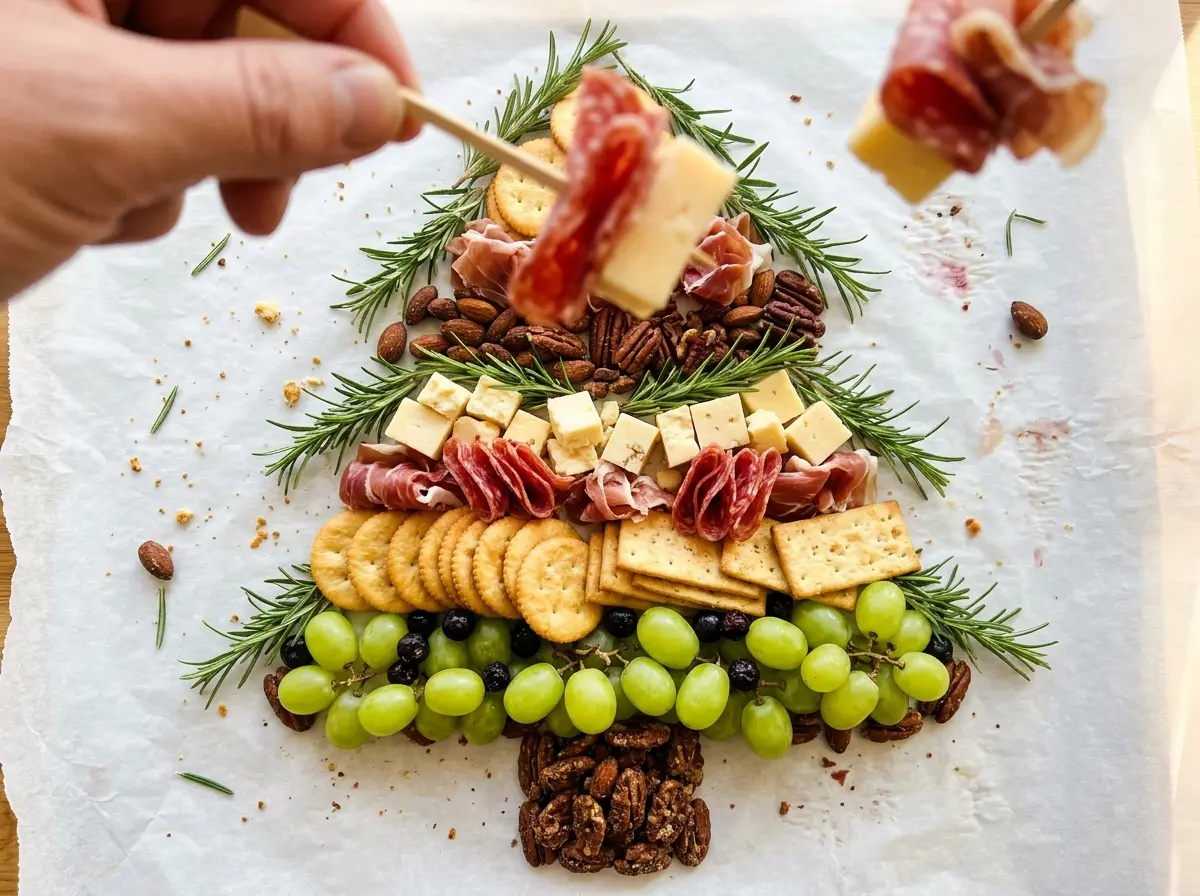
The board starts to look like a tree as soon as the rows stop running straight across and begin narrowing toward the top. I like setting out the ingredients before arranging anything; with the grapes, tomatoes, cheeses, olives, salami, and prosciutto ready to go, it’s easier to see where each color belongs. This Charcuterie Tree is a festive way to serve familiar snack-board ingredients without needing a special mold or complicated assembly.
The details that make the shape read clearly are simple: a cheddar star at the top, rosemary tracing the edges, and pretzel rods gathered at the bottom for the trunk. I cut the cheeses into bite-size cubes and keep the fruit and tomatoes thoroughly dry so the board stays neat. On an 18×12-inch serving board, the rows have room to widen gradually toward the base, and the finished tree serves eight.
Kitchen Note
Use a thin cheddar slice for the star rather than trying to cut one from a cube. A small star sits cleanly at the top without taking up space meant for the rows.
Save this Charcuterie Tree for a party board with a cheddar star, rosemary edges, and a pretzel-rod trunk.
Why the Rows Matter More Than a Perfectly Symmetrical Tree
A snack board can have all the right ingredients and still look more like a pile than a centerpiece. The shape comes from the spacing and outline: the top stays narrow, each row below it grows wider, and the bottom gives the tree a clear base. That gradual change in width helps the eye read the arrangement as a tree, even when the individual pieces aren’t lined up with ruler precision.
Think of the rosemary as a soft border rather than another row of food. It marks the outside edge and helps define the silhouette, while the star and pretzel rods give the top and bottom distinct endpoints. Keep the ingredients within those edges and leave enough room for each row to remain recognizable. You don’t need to make every row identical; the salami, prosciutto, cheese cubes, fruit, and olives naturally have different shapes. A little variation keeps the board from looking rigid, while the narrowing outline keeps the overall design intentional.
The 18×12-inch board gives the tree room to spread across the lower rows without crowding the trunk. Starting at the top lets you judge the remaining space as you build downward. If the lower rows are too narrow, the shape can look like a narrow stack; if they widen steadily, the cheese and produce form a clear, generous base.
What Each Ingredient Brings to the Tree
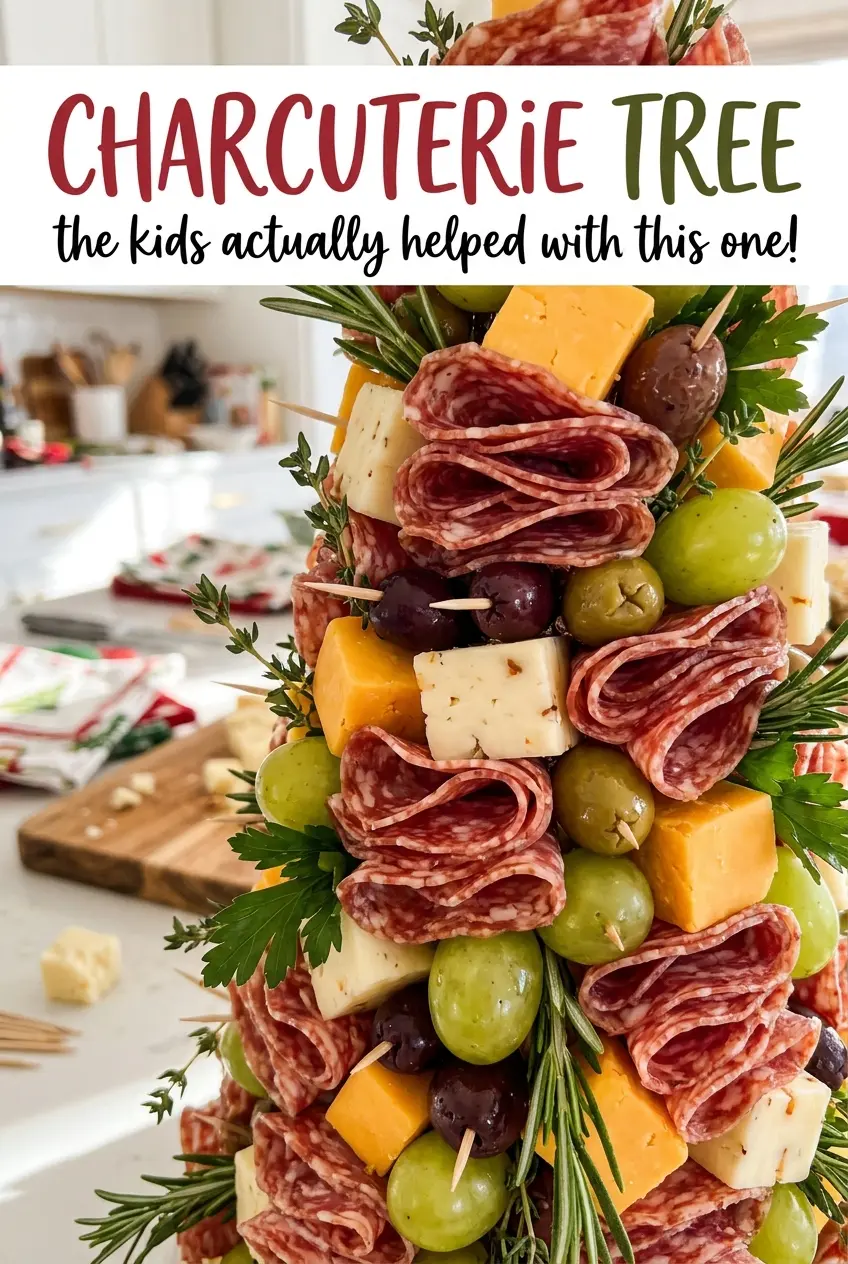
- Sharp cheddar — Its firm texture makes it useful both for bite-size cubes and for the star at the top. Cut the star from a thin slice, then cube the rest. A different cheese would change the star’s color and sharp taste, so cheddar is doing more than filling a row.
- Monterey Jack — These cubes bring a milder cheese alongside the sharp cheddar, giving the board a second cheese option without changing the tree’s simple palette. Cut the block into bite-size pieces so it’s easy to pick up from the rows.
- Salami and prosciutto — The two thinly sliced cured meats give the tree variety beyond the cheese and produce. Their slices can fit into rows more easily than large, thick pieces. Keep both in the tree arrangement rather than piling them separately, so the outline stays visible.
- Red grapes and cherry tomatoes — Both add rounded shapes and color among the cubes and slices. Wash them and dry them thoroughly before arranging; lingering water can make the board look wet and make the rows harder to keep tidy.
- Pitted green olives — Since the pits are already removed, the olives are ready to place and easy to serve from the board. Their smaller size is useful for filling spaces between the larger pieces without needing to cut them.
- Fresh rosemary and pretzel rods — Rosemary sprigs make the tree’s edges, while the pretzel rods gather into a trunk at the base. These elements provide the outline and finishing shape rather than replacing any of the snack rows.
Assemble the Tree from the Star Down
Prepare the produce and cut the cheeses
Wash the grapes and cherry tomatoes, then dry them thoroughly before they go on the board. Cut a small star from a thin slice of cheddar and cut the remaining cheddar and Monterey Jack into bite-size cubes. Keeping the star separate from the cubes makes it easy to place at the top when the tree takes shape. Set the ingredients out where you can reach them, so you can build the rows without stopping to prep as you go.
Shape the rows on the serving board
Use an 18×12-inch serving board and arrange the salami, prosciutto, cheeses, grapes, tomatoes, and olives in rows. Begin with a narrow top and widen each row toward the bottom; this taper is what gives the arrangement its tree outline. Place the cheddar star above the narrowest point. If the rows begin to look like one broad block, open up the spacing enough to distinguish the separate bands.
Finish the edges and serve
Lay the rosemary sprigs along the tree’s edges to trace the shape, then gather the pretzel rods together at the base to make the trunk. Check that the star is at the top and that the broadest portion of the tree sits above the trunk. Serve the board immediately, or cover it and refrigerate it until serving. The finished arrangement is ready to put out as one shared board for eight.
Three Ways to Arrange the Same Charcuterie Tree
Give the cheeses their own bands
Keep the cheddar cubes and Monterey Jack cubes together in separate rows, with the star above them. This makes the two cheese choices easy to spot and gives the tree a more orderly, graphic look while using the same ingredients.
Make the lower branches produce-forward
Place the grapes and cherry tomatoes in the wider lower rows, with olives filling out the arrangement. The rounded pieces make the base look fuller, while the salami, prosciutto, and cheese can define the narrower rows above.
Alternate the meat rows
Use one row for salami and another for prosciutto instead of placing both together. The alternating bands give the center of the tree more definition, while the rosemary still provides the outside edge and the pretzel rods keep the trunk clear.
Making Ahead and Serving
- Refrigerator: Cover the assembled board and refrigerate it until serving. The ingredients are best presented chilled, though the arrangement may look less crisp after being covered.
- Freezer: Don’t freeze the assembled tree. Grapes and tomatoes lose their fresh texture after freezing and thawing, and the rows won’t hold their shape.
- Serving: Put the board out close to serving time. Discard perishable food left at room temperature for more than 2 hours, or 1 hour if the temperature is above 90°F.
Questions That Come Up While Building the Tree
Charcuterie Tree
Ingredients
Equipment
Method
- Wash and thoroughly dry the grapes and tomatoes.
- Cut a small star from a thin slice of the cheddar.
- Cut the remaining cheddar and the Monterey Jack into bite-size cubes.
- On an 18x12-inch serving board, arrange the salami, prosciutto, cheeses, grapes, tomatoes, and olives in rows that form a tree shape, starting narrow at the top and widening toward the bottom.
- Place the cheddar star at the top, the rosemary along the tree’s edges, and the pretzel rods together at the base for a trunk.
- Serve immediately, or cover and refrigerate until serving.
- Discard perishable food left at room temperature for more than 2 hours, or 1 hour if the temperature is above 90°F.