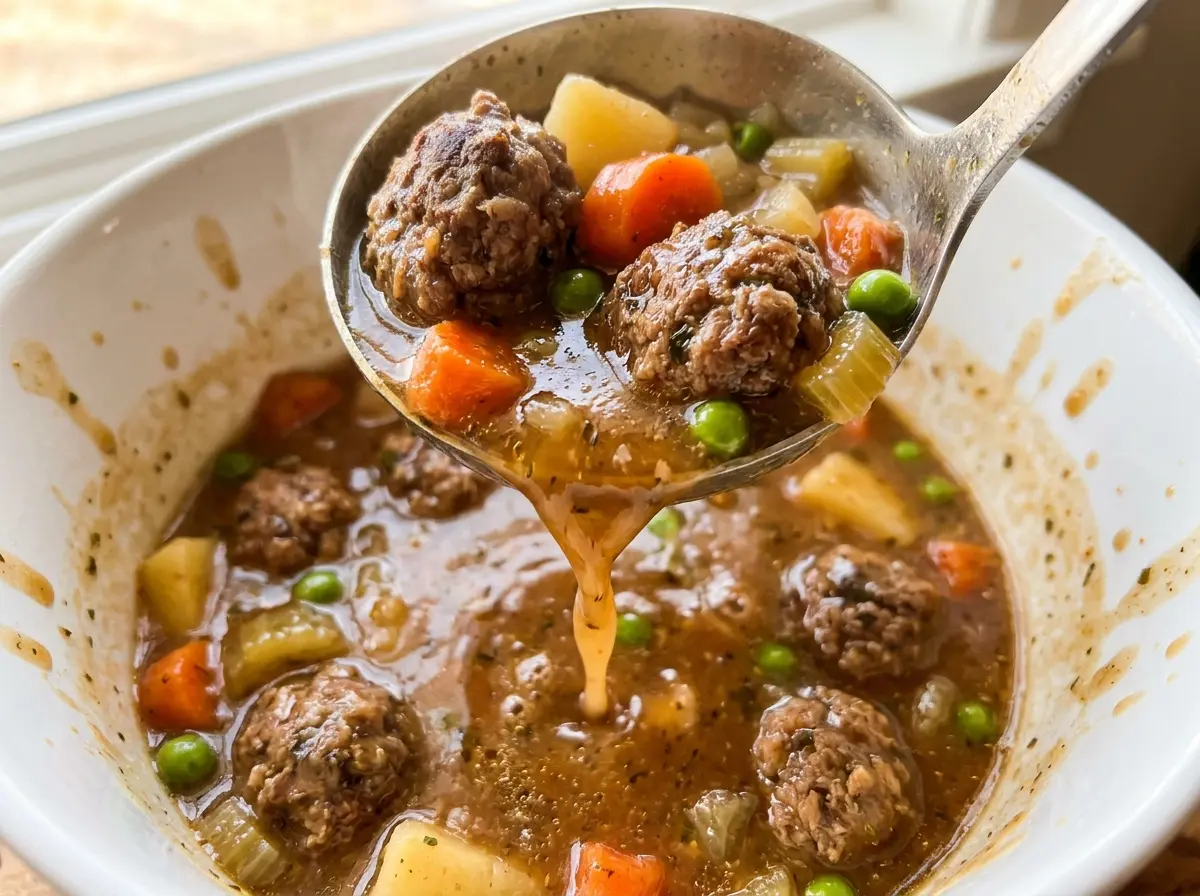
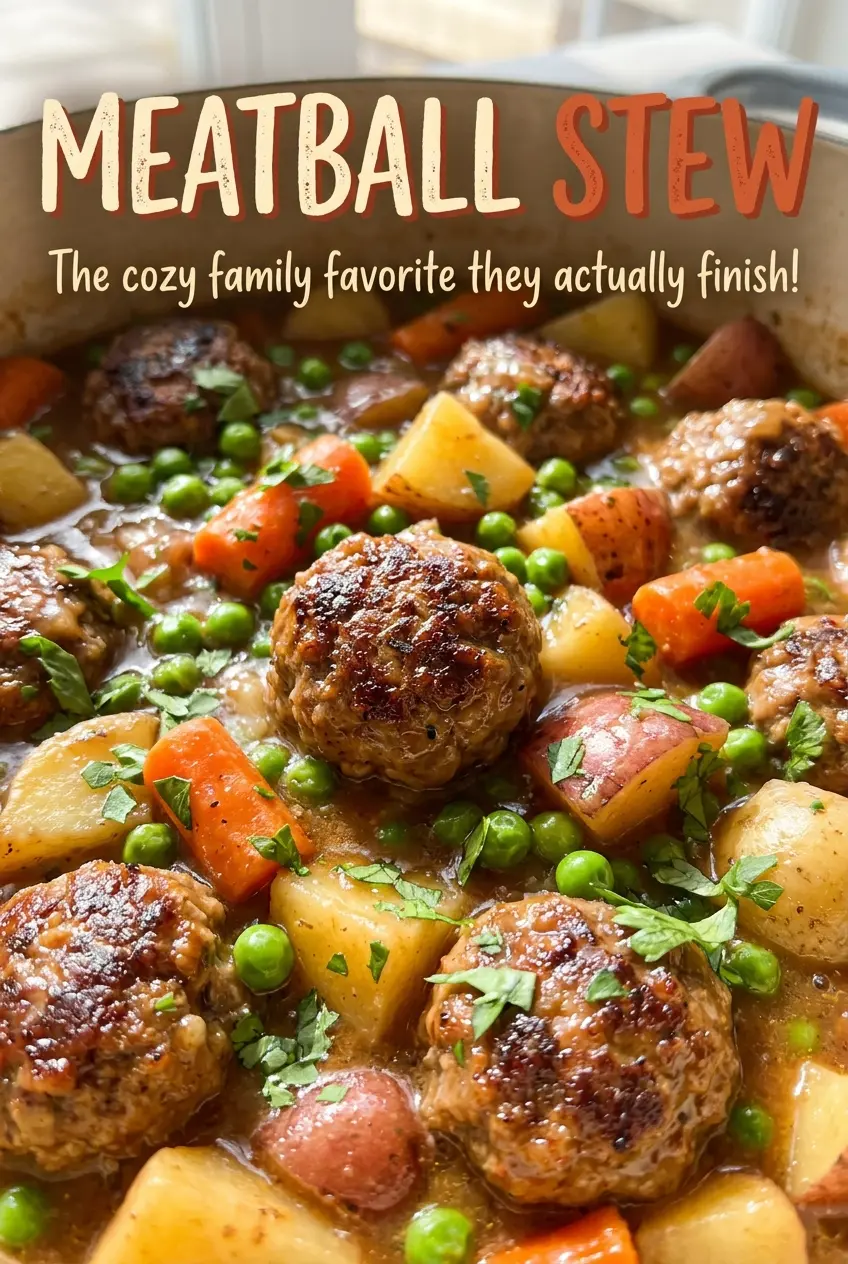
The first meatball sizzles in the Dutch oven, and the kitchen starts to smell like dinner before the vegetables even go in. I brown these meatballs in batches, then build the stew in the same pot, so the broth picks up the savory bits left behind. Meatball Stew has the comfort of a slow-simmered dinner without asking you to wait all afternoon.
Using both beef and pork gives the meatballs a hearty flavor with a softer bite, while Yukon Gold potatoes keep their shape as they simmer. The vegetables cook right alongside the meatballs, and frozen peas go in at the end so they stay bright instead of turning dull and soft. Each spoonful has a little of everything, with a broth that clings to the potatoes and carrots.
Kitchen Note
Mix the meatball ingredients only until they come together. A few uneven flecks are fine; working the mixture until smooth makes the meatballs dense instead of tender.
Save this Meatball Stew for a cozy one-pot dinner, with tender beef-and-pork meatballs and vegetables in a savory broth.
Why the Flour Goes Into the Pot Before the Broth
A stew can taste rich and still have a thin, watery finish. Here, flour is cooked briefly with the softened onion and oil before any broth is added. The fat coats the flour, and that gives it a chance to thicken the liquid evenly instead of leaving little dry clumps floating through the pot.
Whisking in the broth gradually matters because the flour mixture needs time to loosen as the liquid goes in. Pour it all in at once and you’re more likely to chase lumps around the Dutch oven. Cooking the flour for a minute first also takes away its raw, pasty taste. The result is a lightly thickened broth that gathers around the meatballs and vegetables without becoming a heavy gravy.
This order is especially useful in a stew with several different textures. The potatoes contribute a little starch as they cook, but they aren’t responsible for thickening the whole pot. That means the broth can stay smooth even when the vegetables are tender and the meatballs are ready.
What the Beef-Pork Blend and Yukon Golds Bring to the Pot
- Ground beef and ground pork — The beef gives the meatballs a classic, savory base, while pork adds a softer texture. The 85% lean beef is a practical choice here: it has enough fat for tender meatballs without leaving a greasy layer in the pot. You don’t need premium ground meat; fresh, well-handled meat from the regular grocery case works. For an all-beef version, use the variation below.
- Breadcrumbs, milk, and egg — These ingredients help the meatballs stay tender and hold together through browning and simmering. Plain breadcrumbs keep the flavor neutral, and whole milk softens them before they bind into the meat. For a gluten-free pot, use plain gluten-free breadcrumbs and a one-to-one gluten-free flour blend in the broth.
- Yukon Gold potatoes — Their creamy centers and relatively firm shape suit a covered simmer. Choose potatoes that feel firm and aren’t sprouting; there’s no need to peel them if you like the skin. Russets can stand in, but they break down more easily and make the broth cloudier.
- Low-sodium beef broth, Worcestershire, and thyme — Low-sodium broth lets the seasoning stay balanced as the liquid reduces slightly. A grocery-store broth is fine; there’s no need to seek out a specialty brand. Worcestershire and dried thyme deepen the savory taste, while the bay leaf lends a quiet herbal note without taking over.
- Carrots, celery, onion, peas, and parsley — Fresh carrots and celery add sweetness and a little structure, and a yellow onion makes a mellow base. Frozen peas are convenient and keep their color when added near the end. Fresh parsley brings a clean herbal finish to the meatballs; chop it just before mixing for the brightest flavor.
Building the Meatballs and Letting the Stew Simmer Gently
Mix and Shape the Meatballs
Combine the beef, pork, breadcrumbs, egg, milk, garlic, parsley, and the portion of salt and pepper for the meatballs in a large bowl. Stop as soon as the mixture is evenly combined; it shouldn’t look like a smooth paste. Shape it into about 24 meatballs, each roughly 1 1/2 inches wide, keeping them close in size so they cook evenly. If the meatballs are much larger or smaller, they won’t finish at the same pace.
Brown in Batches, Not All at Once
Heat 1 tablespoon of the vegetable oil in a 6-quart Dutch oven over medium-high heat. Brown the meatballs in batches, turning them gently, for about 5 minutes per batch, then transfer them to a plate. They should have browned patches rather than a uniform gray surface. Crowding the pot drops the heat and makes the meatballs steam, so leave room to turn them without squeezing them together.
Soften the Onion and Build the Broth
Add the remaining oil and the chopped onion to the pot, then cook over medium heat, stirring occasionally, for 4–5 minutes, until softened. Stir in the flour and cook for 1 minute so it’s no longer raw-smelling. Gradually whisk in the beef broth, then stir in the Worcestershire sauce, thyme, bay leaf, and the remaining salt and pepper. Bring the liquid to a simmer before adding the vegetables.
Simmer the Vegetables, Then Add the Peas
Add the potatoes, carrots, celery, and browned meatballs, including any juices left on the plate. Cover and simmer gently for 20–25 minutes, until the vegetables are tender and the centers of the meatballs reach 160°F. Keep the simmer gentle; a hard boil can knock the meatballs against one another and break them apart. Stir in the frozen peas and simmer uncovered for 3–5 minutes, just until they’re heated through.
Three Useful Ways to Adapt Meatball Stew
Make the Stew Gluten-Free
Replace the plain breadcrumbs with gluten-free breadcrumbs, and use a one-to-one gluten-free flour blend in place of the all-purpose flour. Choose gluten-free Worcestershire sauce as well, since some brands contain ingredients with gluten. The broth will still thicken, though the exact texture can vary a little by flour blend.
Use All Beef for a Firmer Meatball
Replace the beef-and-pork combination with 1 1/2 pounds of 85% lean ground beef. Keep the rest of the meatball ingredients the same. The flavor will be more distinctly beefy, and the meatballs will have a slightly firmer bite than the beef-pork blend.
Leave Out the Flour for a Brothier Stew
Skip the flour and the step of cooking it with the onion. Whisk the broth gradually into the softened onion instead. The stew will be lighter and more broth-forward rather than thickened, but the vegetables and meatballs will still make a satisfying bowl.
Storage and Reheating
- Refrigerator: Store in airtight containers for 3–4 days. The potatoes soften a little as they sit in the broth.
- Freezer: Freeze in portions for up to 2–3 months. The potatoes may be softer after thawing, but the meatballs and broth hold up well.
- Reheating: Warm gently on the stovetop over medium-low heat, stirring carefully. If the broth has thickened, loosen it with a splash of beef broth, and heat the stew to 165°F; a hard boil can break up the meatballs.
Questions That Come Up When Making Meatball Stew
Meatball Stew
Ingredients
Equipment
Method
- In a large bowl, gently mix the ground beef, ground pork, breadcrumbs, egg, milk, garlic, parsley, 3/4 teaspoon salt, and 1/4 teaspoon pepper until just combined.
- Shape the mixture into about 24 meatballs, each about 1 1/2 inches wide.
- Heat 1 tablespoon oil in a 6-quart Dutch oven over medium-high heat; brown the meatballs in batches, turning gently, about 5 minutes per batch, then transfer them to a plate.
- Add the remaining 2 tablespoons oil and the onion to the pot; cook over medium heat, stirring occasionally, until softened, 4–5 minutes.
- Stir in the flour and cook for 1 minute.
- Gradually whisk in the broth, then stir in the Worcestershire sauce, thyme, bay leaf, remaining 1/4 teaspoon salt, and remaining 1/4 teaspoon pepper; bring to a simmer.
- Add the potatoes, carrots, celery, and meatballs with any juices. Cover and simmer gently for 20–25 minutes, until the vegetables are tender and the centers of the meatballs reach 160°F.
- Stir in the peas and simmer uncovered for 3–5 minutes, until heated through.